
Passing on your business through a management buyout

You have built your business, and it has been a journey! Massive highs, some challenging lows. You have come through it all and you have this brilliant business full of amazing people doing something that you can all be proud of. You also know that it is time to move on and hand the reins to the next generation.
You don’t want to sell to a competitor or to a large finance house. You want your team to take it forward and benefit from all the hard work that they have and will continue to put in. They don’t have the money to pay you what the business is worth. What do you do?
Well, could you do a management buyout – usually referred to as an MBO.
How an MBO works in practice
1.
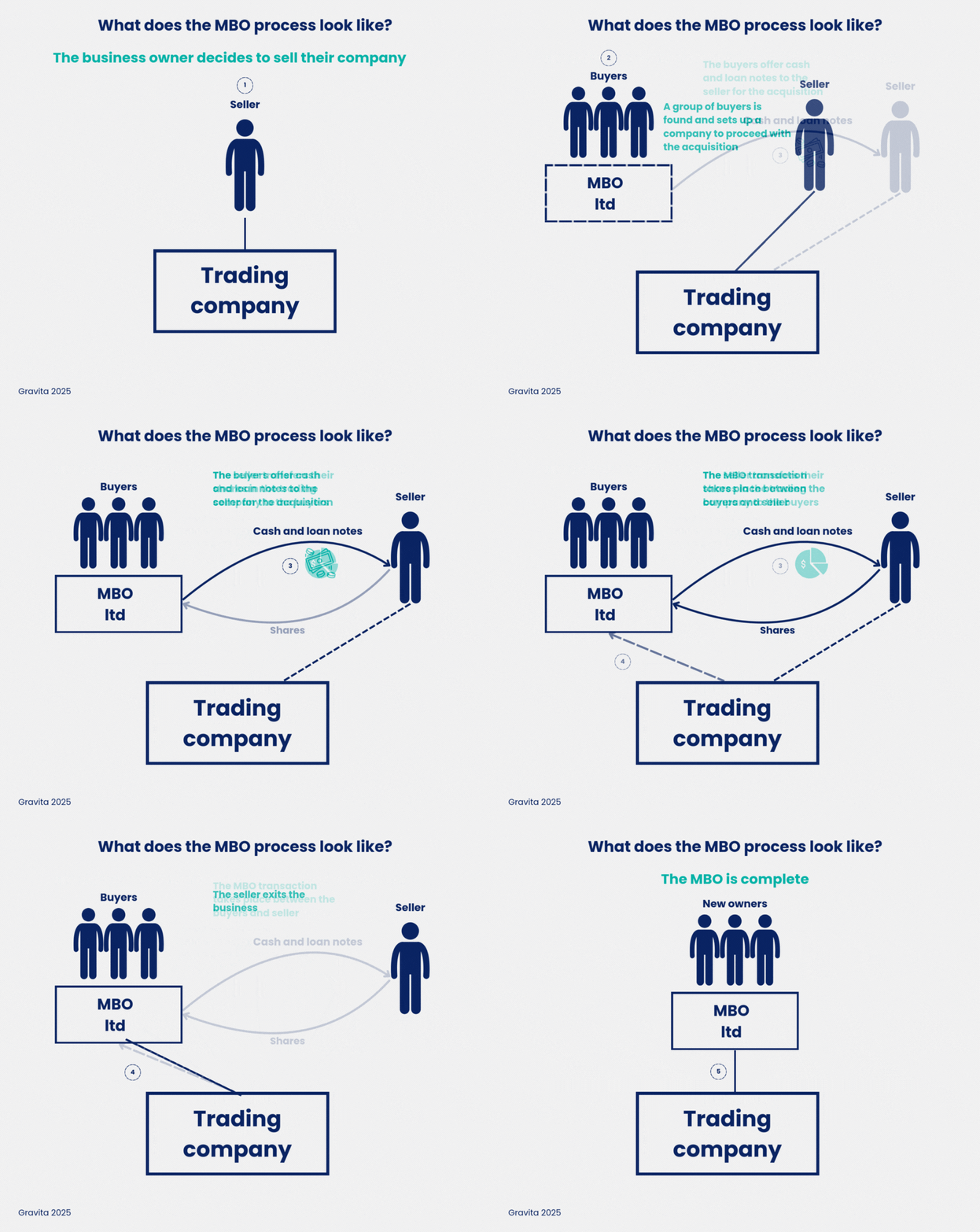
The team that you would like to take the business forward set up their own company – MBO Limited.
2.
MBO Limited then offers to buy your shares (and maybe not all of them if you want to keep a few for sentimental reasons) for what they are worth. A professional valuation will almost certainly be required to support the transaction.
3.
You agree and sell your shares to MBO Limited in return for a loan note and, usually, some cash. The loan note is typically paid off over 2-5 years.
A loan note is simply an IOU wrapped in a legal document that often secures what you are owed against the assets of the company issuing it. In this case it would secured against the value of your company and its assets which is what MBO Limited now owns. For tax purposes, they are very useful as, if structured properly, you can hold or roll over your gain on the shares and only pay the tax when you redeem part or all of your loan note for cash. They can also make sure that you only pay tax on the cash you receive – which can of course be lower than what you sell it for if things don’t work out. We will come back to the tax further below.
So how does MBO Limited get the cash to pay you? Well, it gets this from the trading company it now owns by either declaring and receiving a dividend (which it can do free of tax) or by borrowing money from the trading company (which may itself borrow money from a financial institution).
It is probably helpful to show how this all works with a diagram.
The tax treatment and why clearance matters
From a tax perspective, you as the seller will trigger a capital gain which is usually subject to capital gains tax at your prevailing rate with the benefit of business asset disposal relief (if applicable), which reduces the tax rate to 14% for the first £1million of consideration (rising to 18% from April 2026) from the usual rate of 24% (for most transactions).
We say ‘usually subject to capital gains tax’, as it is possible that HMRC could charge the transaction to income tax as a dividend – raising the tax liability to as much as 39.35% – where certain anti-avoidance legislation applies. To some extent it is possible to get a level of comfort that you will obtain capital gains tax treatment by requesting and obtaining advance clearance from HMRC, which we strongly suggest that you do.
What this means for the management team
The end result for the team taking it forward is that they will own the business through their interest in MBO Limited, and will be able to settle the amount due to you without first having to take the money out of the company into their own hands which will of course trigger significant tax liabilities on them. Again, HMRC can challenge this arrangement and again it will be included within the clearance application to get a level of comfort that the desired tax outcome is achieved.
Of course, this is very much a stripped back and simplified version of how an MBO works, and there are many factors – including tax- that we have either only grazed the surface of or not mentioned at all (like inheritance tax for example). But, where you do not want to sell to a third party, and you are not keen on an employee ownership trust (EOT), an MBO is a very practical and pretty tax efficient way of passing on your business to the next generation.
Similar Insights

Tax due diligence for UK companies

Inheritance Tax on pensions: what the 2027 changes mean for your estate

Unfair dismissal reform and what every employer needs to do before January 2027
Sign up to Gravita's latest updates and newsletters
Stay up-to-date with our event invites, latest news and updates, straight from Gravita's experts.